Skip to content

24/7 dementia helpline 800-272-3900

Dementia Today

Archive

All articles

540 articlesPage 35 of 45

Dementia News

Nerve protein linked to learning and memory

Can the nerve signaling inhibitor tomosyn help retain long-term memory? A new study by two University of Illinois at Chicago biologists points to the link. Findings by Janet Richmond and David Featherstone, both professors of biological sciences at UIC, are

3 min read

Alcohol-Related Dementia

Wernicke-Korsakoff Syndrome, also known as Wet Brain

Wernicke-Korsakoff Syndrome is also known as: Korsakoff’s psychosis, alcoholic encephalopathy, Wernicke’s disease, or more commonly referred to as wet brain. Wernicke-Korsakoff Syndrome is caused by a Thiamine (vitamin B1) deficiency and causes a severe memory disorder. Chronic, heavy consumption of

6 min read

Alcohol-Related Dementia

An Overview Of Wernicke-Korsakoff Syndrome

Definition Wernicke-Korsakoff Syndrome (WKS) is a neurological disorder. Wernicke’s Encephalopathy and Korsakoff’s Psychosis are the acute and chronic phases, respectively, of the same disease. WKS is caused by a deficiency in the B vitamin thiamine. Thiamine plays a role in

12 min read

Wernicke-Korsakoff Syndrome
Alcohol-Related Dementia

Wernicke-Korsakoff Syndrome

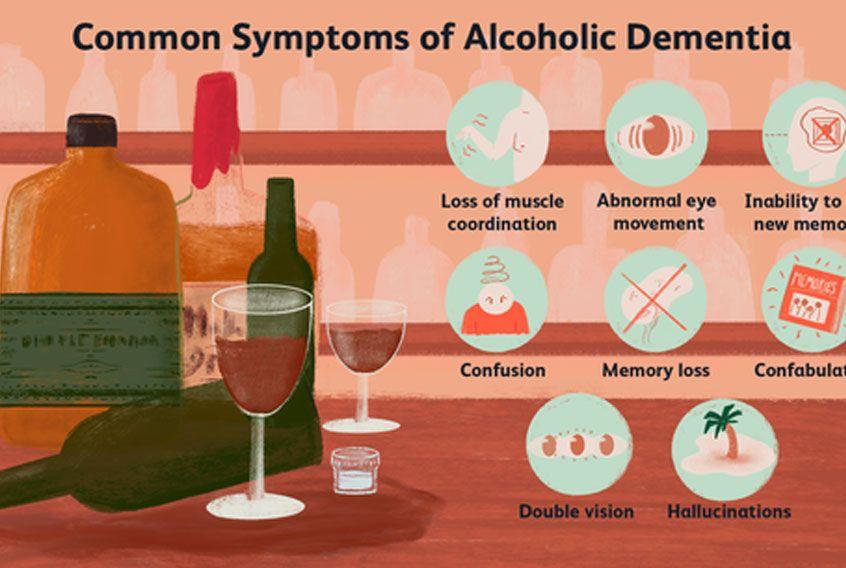
When persistent learning and memory deficits are present in patients with Wernicke encephalopathy (a clinical triad of confusion, ataxia, and nystagmus [or ophthalmoplegia]), the symptom complex is often called Wernicke-Korsakoff syndrome. Clinically, this term is best conceptualized as 2 distinct

13 min read

Worried about memory changes?

Normal aging, or an early warning sign?

Ten common changes, each set beside what is typical with age. Tick what you have noticed and see what to do next.

Open the 10-sign checklist

Getting help

Sudden changes are not just the dementia.

Dementia usually changes slowly. A sharp change over hours or days can mean an infection, delirium, a stroke or a medication problem, and needs a doctor the same day. Call 911 or your local emergency number if you see any of these:

  • Confusion that comes on suddenly, over hours or days
  • Face drooping, arm weakness or slurred speech
  • A fall, a head injury or new severe pain
  • Very drowsy or hard to wake

The free Alzheimer’s Association Helpline answers questions about memory loss, diagnosis and caregiving, day and night, in more than 200 languages (US).

If someone with dementia is missing

  1. STEP 115 minSearch close by firstCheck the house, garden, car and the places the person often walks to. Don’t spend longer than about 15 minutes.
  2. STEP 2911Then call for helpTell the operator the person has dementia and is a vulnerable adult. Police treat this as urgent.
  3. STEP 3PhotoHave details readyA recent photo, what they were wearing, medical conditions and places they used to live or work.

Based on Alzheimer’s Association guidance on wandering. Outside the US, call your local emergency number.