
Skip to content

24/7 dementia helpline 800-272-3900

Dementia Today

Archive

All articles

540 articlesPage 41 of 45

Functional Imaging
Aging & Dementia

Functional Imaging

Functional imaging methods used in research on aging, mild cognitive impairment, and dementia of the Alzheimer type include single-photon emission computed tomography (SPECT), positron emission tomography (PET), and functional magnetic resonance imaging (fMRI). Positron emission tomography and single-photon emission computed

9 min read
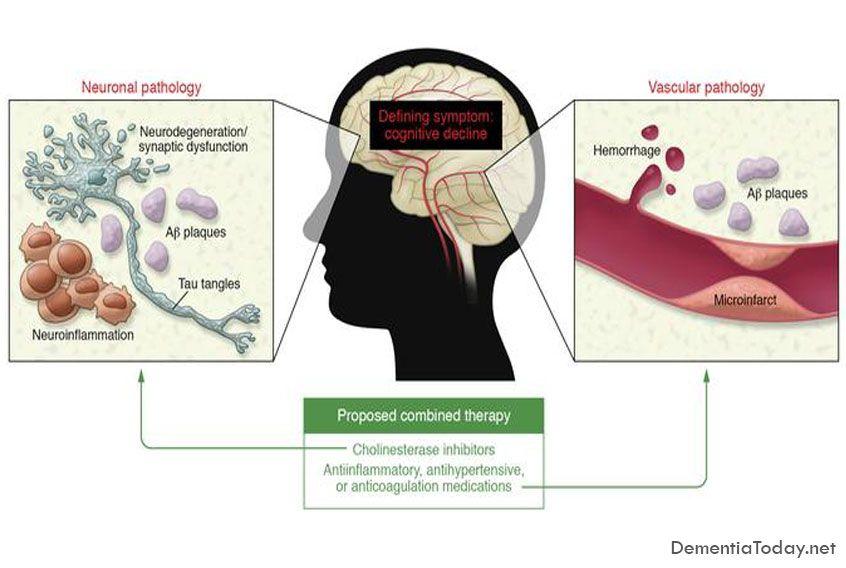
An important advance in the evaluation of people with suspected dementia of the Alzheimer type is the use of structural imaging to assess in vivo neuroanatomical changes. This technique can also be used in conjunction with neuropsychological test data to better understand the relationship between the structural brain changes and the cognitive deficits that characterize the disease.
Aging & Dementia

Structural Imaging

An important advance in the evaluation of people with suspected dementia of the Alzheimer type is the use of structural imaging to assess in vivo neuroanatomical changes. This technique can also be used in conjunction with neuropsychological test data to

7 min read

Dementia News

Cognition and Cognitive Testing

As noted above, the diagnoses of mild cognitive impairment and dementia of the Alzheimer type both require the presence of memory impairment. To distinguish between MCI and DAT, it is important to determine the degree and course of memory impairment,

11 min read

Dementia News

10 Warning Signs of Alzheimer’s and Dementia

How do you know if your parent has Alzheimer’s disease or dementia? If dad continually forgets where he puts his keys, or mom seems to get easily confused these days, does it mean they have Alzheimer’s? Not necessarily. Only a

5 min read

Dementia News

Types of Dementia Parkinson’s Disease

Parkinson’s Disease is a common disorder of deep brain structures that help control movement. Over time, many people with Parkinson’s disease develop Parkinson’s Disease Dementia. The majority of Parkinson’s Disease patients over the age if 65 develop dementia within a

8 min read

Dementia News

Types of dementia

There are many types of dementia. The effects of the different types of dementia are similar, but not identical, as each one tends to affect different parts of the brain. There are over 100 diseases that can cause dementia. The

1 min read

Understanding Dementia

Causes and Types of Dementia

What Causes Dementia? There are a number of diseases and conditions that can cause dementia. For many people there is still the question “Why me?” Dementia is not an inevitable consequence of ageing, but it is more common among older

2 min read

Vascular Dementia

Symptoms of vascular dementia

People with vascular dementia may experience: Patchy cognitive defects – this means that the damage is localised. A person may have, for example, big problems with memory, but still be able to carry on a normal conversation. Difficulty with making

3 min read

Vascular Dementia

Vascular dementia - Tests and diagnosis

Vascular dementia is the second most common form of dementia after Alzheimer disease (AD). The condition is not a single disease; it is a group of syndromes relating to different vascular mechanisms. Vascular dementia is preventable; therefore, early detection and

5 min read

Vascular Dementia

Coping Strategies for Vascular Dementia Caregivers

Vascular dementia (VaD) is one of the most common types of dementia in older adults. It causes a subtle, progressive decline of memory and other brain function, such as thinking, learning, remembering, organization skills and complex visual processing, and is

10 min read

Worried about memory changes?

Normal aging, or an early warning sign?

Ten common changes, each set beside what is typical with age. Tick what you have noticed and see what to do next.

Open the 10-sign checklist

Getting help

Sudden changes are not just the dementia.

Dementia usually changes slowly. A sharp change over hours or days can mean an infection, delirium, a stroke or a medication problem, and needs a doctor the same day. Call 911 or your local emergency number if you see any of these:

  • Confusion that comes on suddenly, over hours or days
  • Face drooping, arm weakness or slurred speech
  • A fall, a head injury or new severe pain
  • Very drowsy or hard to wake

The free Alzheimer’s Association Helpline answers questions about memory loss, diagnosis and caregiving, day and night, in more than 200 languages (US).

If someone with dementia is missing

  1. STEP 115 minSearch close by firstCheck the house, garden, car and the places the person often walks to. Don’t spend longer than about 15 minutes.
  2. STEP 2911Then call for helpTell the operator the person has dementia and is a vulnerable adult. Police treat this as urgent.
  3. STEP 3PhotoHave details readyA recent photo, what they were wearing, medical conditions and places they used to live or work.

Based on Alzheimer’s Association guidance on wandering. Outside the US, call your local emergency number.