Dementia Today
Old age was considered an important factor in the development of arteriosclerosis (Berrios, 1994) and a risk factor in diseases such as melancholia (Berrios, 1991). By 1910, there was a trend to include all dementias under ‘mental disorders of cerebral arteriosclerosis’ (Barrett, 1913). Arteriosclerosis, might be generalized or cerebral, inherited or acquired, and caused by syphilis, alcohol, nicotine, high blood pressure or ageing. In those genetically predisposed, cerebral arteries were considered as thinner and less elastic. Arteriosclerosis caused mental changes by narrowing of arteries and/or reactive inflammation. The view that arteriosclerotic dementia resulted from a gradual strangulation of blood supply to the brain was also formed during this period; consequently, emphasis was given to prodromal symptoms, and strokes were but the culmination of a process started years before.
Some opposed this view from the beginning. For example, Marie (1906) claimed that such explanation was a vicious circle, as alienists claimed that: ‘ageing was caused by arteriosclerosis and the latter by ageing’ (p. 358), and Walton (1912) expressed serious doubts from the histopathological point of view. The frequent presence in post mortem of such changes also concerned pathologists who worried that they could not ‘safely exclude cerebral arteriosclerosis of greater or lesser degree in any single case’ of senile dementia (p. 677) (Southard, 1910).
Based on a review of these arguments, Olah (1910) concluded that there was no such thing as ‘arteriosclerotic psychoses’. However, the ‘chronic global ischaemia’ hypothesis won the day, and it was to continue well into the second half of the twentieth century. For some it became a general explanation; for example, North and Bostock (1925) reported a series of 568 general psychiatric cases in which around 40 per cent suffered from ‘arterial disease’, which – according to the authors – was even responsible for schizophrenia. The old idea of an apoplectic form of dementia, however, never disappeared.
1.5.5 Apoplectic dementia
‘Apoplectic dementia’ achieved its clearest enunciation in the work of Benjamin Ball (Ball and Chambard, 1881). ‘Organic apoplexy’ resulted from bleeding, softening or tumour and might be ‘followed by a notable decline in cognition, and by a state of dementia which was progressive and incurable … of the three, localized softening (ramollissement en foyer) caused the more severe states of cognitive impairment’ (p. 581).
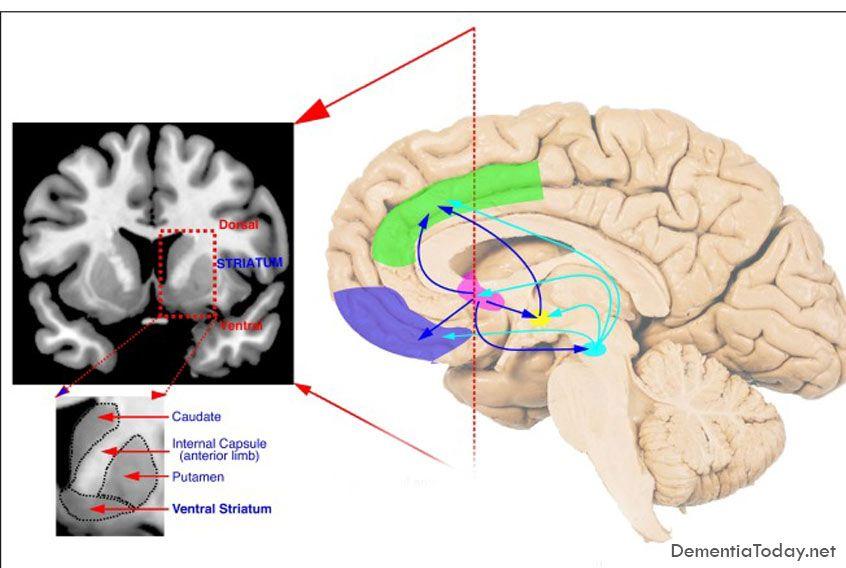
Ball believed that prodromal lapses of cognition (e.g. episodes of somnolence and confusion with automatic behaviour, for which there was no memory after the event) and sensory symptoms were caused by atheromatous lesions. Visual hallucinations, occasionally of a pleasant nature, were also common. After the stroke, persistent cognitive impairment was frequent. Post-mortem studies showed in these cases softening of ‘ideational’ areas of cortex and white matter. Ball also suggested a laterality effect (p. 582) in that right hemisphere strokes led more often to dementia whereas left hemisphere ones caused perplexity, apathy, unresponsiveness, and a tendency to talk to oneself (p. 583). Following Luys, he believed that some of these symptoms resulted from damage to corpus striatum, insular sulci and temporal lobe. During Ball’s time, attention also shifted from white to red softening.
Charcot (1881) wrote on cerebral haemorrhage (the new name for red softening): ‘having eliminated all these cases, we find ourselves in the presence of a homogeneous group corresponding to the commonest form of cerebral haemorrhage.
This is, par excellence, sanguineous apoplexy … as it attacks a great number of old people, I might call it senile haemorrhage’ (p. 267).
###
Edited by
Alistair Burns MPhil, MD, FRCP, FRCPsych
Professor of Old Age Psychiatry,
Wythenshawe Hospital,
Manchester, UK
John O’Brien MA, DM, FRCPsych
Professor of Old Age Psychiatry,
Institute for Ageing and Health,
University of Newcastle upon Tyne,
Newcastle upon Tyne, UK
David Ames BA, MD, FRCPsych, FRANZCP
Professor of Psychiatry of Old Age,
University of Melbourne, St George’s Hospital, Melbourne,
Victoria, Australia
###
Author:
GERMAN BERRIOS
German Berrios BA (OXFORD), MD, DM H.C. HEIDELBERG, FRCPsych, FBPSS
Professor,
University of Cambridge Department of Psychiatry,
Cambridge, UK
References
- Alzheimer A. (1907) Uber eine eigenartige Erkrankung der Hirnrinde.
- Allgemeine Zeitschrift fur Psychiatrie und Psychisch-Gerichtlich Medizine 64: 146-148
- Alzheimer A. (1911) Uber eigenartige Krankheitsfalle des spateren Alters. Zeitschrift fur die gesamte Neurologie und Psychiatrie 4: 356-385
- Anderson EW, Threthowan WH, Kenna JC. (1959) An experimental investigation of simulation and pseudodementia. Acta Psychiatrica et Neurologica Scandinavica 34 (Suppl. 132)
- Anonymous (1832) An exposure of the unphilosophical and unchristian expedients adopted by antiphrenologists, for the purpose of obstructing the moral tendencies of phrenology. A review of John Wayte’s book. The Phrenological Journal and Miscellany 7: 615-622
- Baillarger J. (1883) Sur la theorie de la paralysie generale. Annales Medico-Psychologiques 35: 18-52; 191-218
- Baillarger J. (1889) Doit-on dans la classification des maladies mentales assigner une place a part aux pseudo-paralysies generales? Annales Medico-Psychologiques 41: 521-525
- Ball B and Chambard E. (1881) Demence. In: A. Dechambre and L. Lereboullet (eds), Dictionnaire Encyclopedique des Sciences Medicales. Paris, Masson, pp. 559-605
- Barrett AM. (1913) Presenile, arteriosclerotic and senile disorders of the brain and cord. In: WA White and SA Jelliffe (eds), The Modern Treatment of Nervous and Mental Diseases. London, Kimpton, pp. 675-709