Skip to content

24/7 dementia helpline 800-272-3900

Dementia Today

Topic

Dementia Care

17 articlesPage 2 of 2

What is frontotemporal dementia?
Dementia Care

What is frontotemporal dementia?

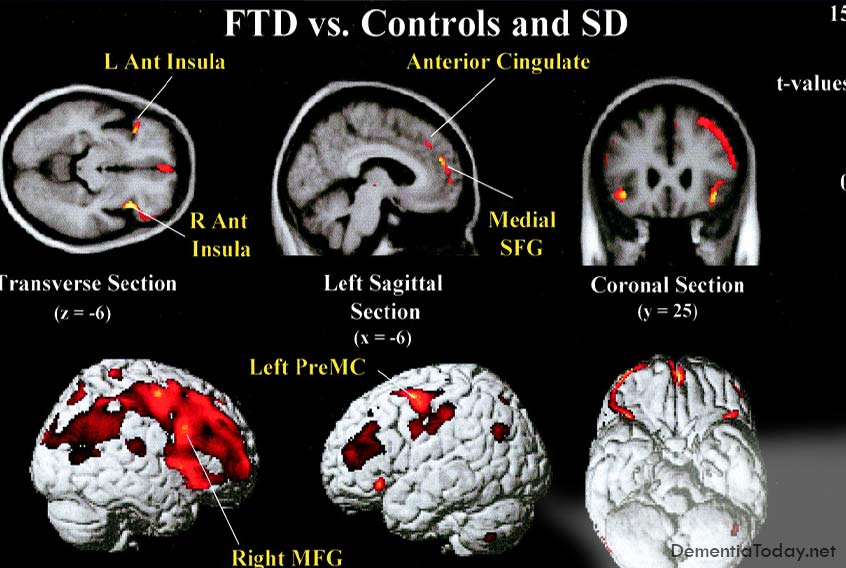
There is a type of dementia called “frontotemporal” which typically affects patients at a very early age. In this type of dementia, there is no true memory loss in the early stages of the type that is seen in Alzheimer’s

14 min read
Dementia Care

Brisk walking may improve symptoms of Parkinson’s

People with mild to moderate Parkinson’s disease who regularly walk for exercise may improve their motor function, mood, tiredness, fitness and some aspects of thinking abilities, according to a study published in the July 2, 2014, online issue of Neurology®,

3 min read

Functional Imaging - Normal Aging & DementiaJun 25, 2011CommentsViewed: 2665 Tags: | brewer | dat | dementia of the alzheimer type | emission computed tomography | Saykin et al. (1999) employed functional magnetic resonance imaging to study semantic and episodic memory processing in a sample of patients with mild dementia of the Alzheimer type. During semantic memory tasks, both patients and controls activated inferior frontal regions, particularly of the left hemisphere. The spatial extent of activation was increased in the group with DAT. Additional right frontal activation was observed in the patients with mild DAT. During an episodic memory (recognition) task, there was an absence of prefrontal activation in persons with DAT compared to controls, with greater activation in the medial temporal region than in controls. Together, these findings suggest that brain activation is not simply diminished as a function of DAT, but may also increase, and that spatial shifts in activation can occur. In fact, increased activation in inferior frontal brain regions subserving semantic memory that were directly related to the extent of local atrophy in persons with DAT have been reported (Johnson et al. 2000). Therefore, alterations in activation may be adaptive as a compensatory mechanism, a possibility that deserves further investigation using functional neuroimaging methods. In another study, Saykin et al. (2000) correlated structure and function, and found that degree of hippocampal atrophy predicted frontal lobe activation during episodic memory. Analyses of functional connectivity provide a new means of analyzing functional magnetic resonance imaging or positron emission tomography data to examine disruption in normal patterns of coactivation of brain regions within a functional circuitry
Aging & Dementia

Clinical Conclusions

Using an evidence-based review of the literature, the Quality Standards Subcommittee of the American Academy of Neurology made three levels of recommendation for clinical practice related to the diagnosis and evaluation of individuals with mild cognitive impairment and dementia (Knopman

4 min read

Worried about memory changes?

Normal aging, or an early warning sign?

Ten common changes, each set beside what is typical with age. Tick what you have noticed and see what to do next.

Open the 10-sign checklist

Getting help

Sudden changes are not just the dementia.

Dementia usually changes slowly. A sharp change over hours or days can mean an infection, delirium, a stroke or a medication problem, and needs a doctor the same day. Call 911 or your local emergency number if you see any of these:

  • Confusion that comes on suddenly, over hours or days
  • Face drooping, arm weakness or slurred speech
  • A fall, a head injury or new severe pain
  • Very drowsy or hard to wake

The free Alzheimer’s Association Helpline answers questions about memory loss, diagnosis and caregiving, day and night, in more than 200 languages (US).

If someone with dementia is missing

  1. STEP 115 minSearch close by firstCheck the house, garden, car and the places the person often walks to. Don’t spend longer than about 15 minutes.
  2. STEP 2911Then call for helpTell the operator the person has dementia and is a vulnerable adult. Police treat this as urgent.
  3. STEP 3PhotoHave details readyA recent photo, what they were wearing, medical conditions and places they used to live or work.

Based on Alzheimer’s Association guidance on wandering. Outside the US, call your local emergency number.